Is RF Microneedling Safe for Darker Skin Tones?
RF microneedling suits most medium to deep skin tones with the right needles and settings. See the main pigment risk, how doctors lower the risk, and when melasma needs extra care.


Quick Answer
- Short answer: Yes, for most people with medium to deep skin, with the right device and settings
- Why: The needles carry energy into the dermis, below the pigment layer
- Main risk: Post-inflammatory hyperpigmentation, or temporary dark marks after treatment
- Key safeguards: Insulated needles, conservative energy, a test spot and strict sun protection
- Melasma: Needs extra caution. Heat raises the risk of a flare.
- Skin types: Fitzpatrick types I to VI, with settings adjusted to each type
Why Does Skin Tone Matter for Skin Treatments?
Medium to deep skin has more active pigment cells. Inflammation, heat or injury prompts these cells to make extra pigment. The result is a dark mark where the skin healed. Doctors call this post-inflammatory hyperpigmentation, or PIH.
Many lasers work through light absorbed by pigment. In darker skin, surface pigment absorbs part of the energy, which raises the risk of burns and dark marks. Many Middle Eastern, South Asian and African skin tones fall in Fitzpatrick types IV to VI. See how laser choice changes with skin tone in Nd:YAG vs diode vs alexandrite.
Why Does RF Microneedling Suit Darker Skin?
- No light: Radiofrequency energy does not depend on pigment. Skin colour does not change how the skin absorbs the energy.
- Energy below the surface: The needles carry energy into the dermis, under the pigment layer.
- Insulated needles: A coating on each needle keeps heat away from the surface layer.
- Small treated zones: Untreated skin between the needle points speeds healing.
Read how the treatment works in RF microneedling vs microneedling.
How Does RF Microneedling Compare With Other Options for Darker Skin?
| Option | Action | Pigment Risk in Darker Skin | Notes |
|---|---|---|---|
| RF microneedling, insulated needles | Heat in the dermis through needles | Low with careful settings | Suits scars, pores and mild laxity |
| RF microneedling, non-insulated needles | Heat along the full needle | Low to moderate | Lower energy settings needed |
| Microneedling | Needle channels only, no heat | Low | Milder effect on deep scars |
| Ablative fractional laser | Removes columns of skin with heat | Higher | Longer downtime. Careful use only. |
| Non-ablative fractional laser | Heats columns under an intact surface | Moderate | Conservative settings needed |
| IPL | Broad-spectrum light | High | Not recommended for darker skin |
| Chemical peels | Acid removes surface layers | Low to high, by peel strength | Mild peels suit most skin tones |
What Is the Main Risk?
PIH is the main risk. Dark marks appear in the weeks after treatment, often as small dots or a faint grid. Most PIH fades over weeks to months with sun protection and topical care. Your doctor treats lasting marks with brightening creams.
Other risks include:
- Redness and swelling for 1 to 3 days
- Grid marks, fading within a week
- Rare burns or blisters with high energy
- Rare raised scars in people prone to keloids
- Cold sore flares in people with a history of cold sores
How Do Doctors Lower the Risk for Darker Skin?
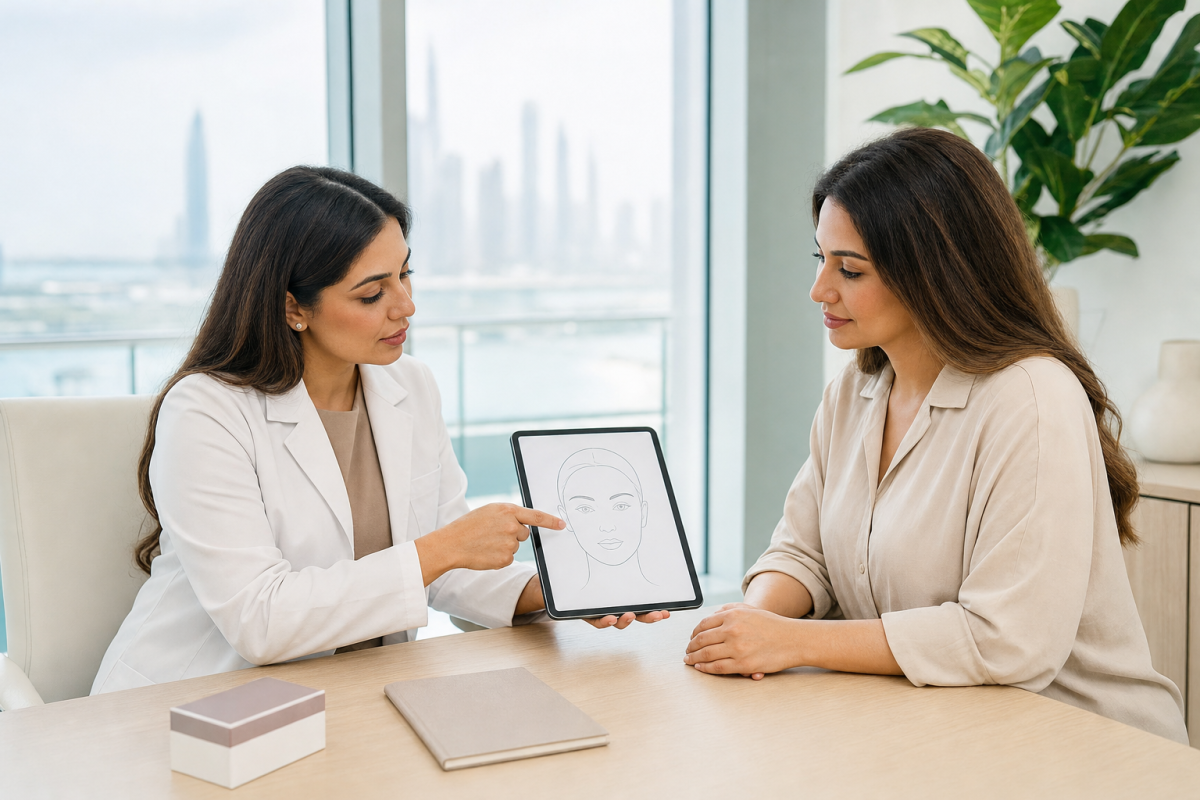
- Skin assessment: Your doctor confirms your skin type, pigment history and any melasma.
- Test spot: Your doctor treats a small area first, often along the jaw, and reviews the response after 1 to 2 weeks.
- Skin preparation: Daily SPF 50 and a doctor-prescribed brightening cream for 2 to 4 weeks before treatment.
- Conservative settings: Insulated needles, lower energy and fewer passes.
- Wider spacing: 4 to 6 weeks between sessions, or longer where the skin needs more recovery time.
- Aftercare: Strict sun protection and a gentle routine. See RF microneedling aftercare.
Is RF Microneedling Safe With Melasma?
Melasma needs extra caution. Heat stimulates pigment cells, and RF microneedling places heat in the skin. For active or flaring melasma, your doctor uses low settings, treats the melasma first or chooses another option.
Not sure whether your dark patches are melasma? Read melasma vs sun spots vs post-acne marks and the full guide to melasma and pigmentation in Dubai.
Who Should Avoid RF Microneedling?
| Situation | Guidance |
|---|---|
| Pregnancy | Avoid |
| Pacemaker or other implanted electrical device | Avoid |
| Active acne, infection or cold sore in the area | Wait until healed |
| Recent tan or sunburn | Wait until the tan fades |
| Isotretinoin in the past 6 months | Doctor assessment first |
| History of keloid scars | Doctor assessment first |
| Active or flaring melasma | Doctor assessment first |
| Metal implants or threads in the area | Doctor assessment first |
| Blood-thinning medication | Doctor assessment first |
How Does the Dubai Sun Affect Treatment?
- A tan raises pigment activity and the risk of PIH
- Your doctor delays treatment or lowers the energy after recent sun
- A course started in the cooler months, from October to April, runs with fewer delays
- Daily tinted SPF 50 protects healing skin. See which sunscreen suits melasma.
Which Questions Should You Ask Before Booking?
- How often do you treat my skin type?
- Which needle type do you use for darker skin?
- Do you perform a test spot first?
- How do you prepare my skin before the first session?
- What happens if dark marks appear after treatment?
- Who performs the treatment, and which licence does the provider hold?
Frequently Asked Questions
Does RF microneedling cause hyperpigmentation?
PIH is the main risk in darker skin. Careful settings, a test spot and sun protection lower the risk. Most marks fade over weeks to months.
Is RF microneedling lower risk than laser for dark skin?
Radiofrequency energy does not depend on skin pigment. For many people with darker skin, this gives a wider safety margin than ablative lasers. Your doctor compares the options for your skin.
Does RF microneedling suit acne scars on brown skin?
Yes, for most people. Rolling and shallow boxcar scars respond to RF microneedling. Ice pick scars often need other methods too. See acne scar treatments.
How many sessions does darker skin need?
Most plans use 3 to 4 sessions, spaced 4 to 6 weeks apart. Your doctor extends the spacing where your skin needs more recovery time.
Does skin preparation matter?
Yes. Daily SPF 50 and a doctor-guided brightening routine before treatment lower the risk of dark marks.
Related Guides
- RF Microneedling at Diva Clinic
- RF Microneedling vs Microneedling
- RF Microneedling Aftercare
- Melasma and Pigmentation in Dubai
- Nd:YAG vs Diode vs Alexandrite
Book a Consultation
Want to know whether RF microneedling suits your skin tone? Message us on WhatsApp to book your skin assessment.
This article is for general educational purposes and does not replace a personalised consultation with a licensed medical aesthetics provider. Individual results vary.